
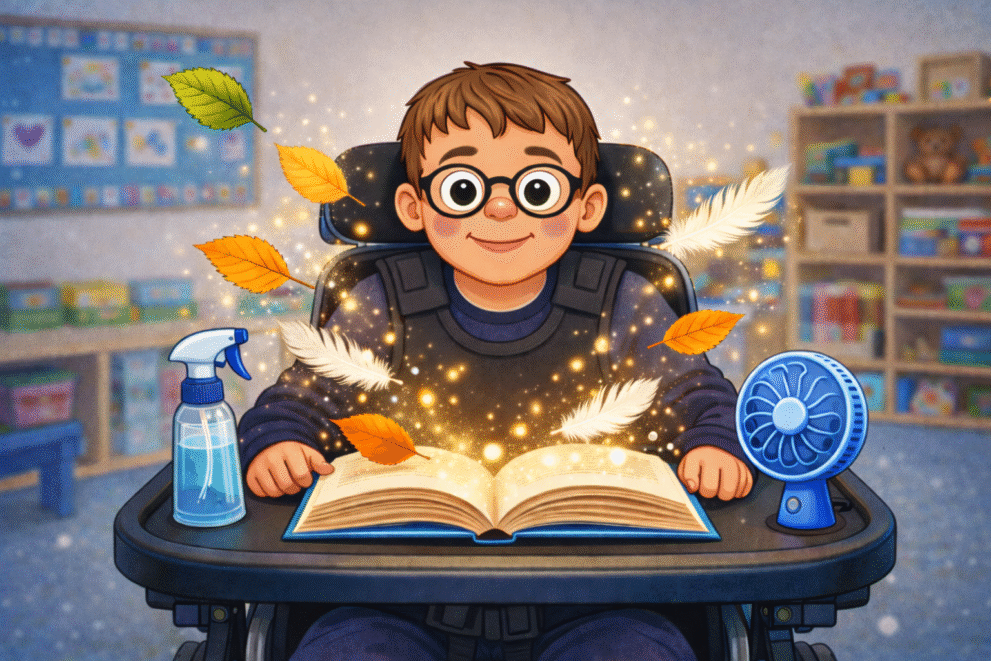
Sensory Stories for Children with Complex Needs
Sensory stories for children with complex needs offer a simple and meaningful way to bring storytelling to life.
Instead of relying on spoken language alone, each sentence in the story is paired with a meaningful sensory experience. The learner does not just hear the story; they feel it through touch, sound, smell, taste or visual effects.
This storytelling style is inclusive and accessible, helping children and young people with PMLD and complex learning needs participate in and enjoy stories in ways that work for them.
What Makes a Good Sensory Story for children with complex needs?
A good sensory story is short and predictable.
Many sensory stories work well when they are about 8–12 simple sentences long. It should feel easy to follow and not overwhelming for the learner.
Repetition is key.
A repeated phrase or steady rhythm helps learners anticipate what comes next. When a story is shared consistently over time, that predictability creates safety, and you may start to notice clearer responses.
Each part of the story needs a sensory moment to bring it to life.
The experience should be purposeful and clearly linked to what is happening in the story. For example:
- If it’s windy: Learners may feel the breeze from a fan across their bodies.
- If it’s sunny: Shining a torch onto a shiny space blanket can create dancing sunlight.
- If it’s snowy: Learners can listen to the crunch of paper, like footsteps in snow.
Without that sensory pairing, the story becomes words alone. With it, the learner can connect, take part and enjoy the experience
The approach and principles behind sensory storytelling are also explored in more depth in books such as Sensory Stories for Children and Teens with Special Educational Needs by Joanna Grace.
ENGAGING ALL OF THE SENSES in sensory stories
The five familiar senses, sight, sound, touch, smell and taste, are the foundation. But the body-based or “hidden” senses matter just as much:
- Vestibular (Movement): Rocking from side to side as if on a pirate boat in a storm.
- Proprioception (Body Awareness): A firm squeeze and a gentle stretch, like a plant pushing out of the ground toward the sunlight.
- Interoception (Internal Feelings): A quiet pause to invite learners to notice their heartbeat after an exciting part of the story.
Including these body-based senses helps the learner’s body stay regulated. Movement can wake the body up. A pause can help it settle. For some learners, these physical experiences are much easier to respond to than spoken language
Preparing Sensory Stories for Children with Complex Needs
Keep your props organised in a labelled box or bag so you can return to the same story again and again.
- Use a checklist: A simple resource list ensures nothing is forgotten.
- Safety first: Check that props are safe and be mindful of allergies or sensitivities.
- Focus: When you are prepared in advance, you can focus fully on the learner rather than searching for materials. It keeps the session calm and unhurried.
Delivering a sensory story
How a sensory story is delivered matters just as much as how it is written.
- Be consistent: Share the story regularly (sometimes for six weeks or more) using the same words and props. This builds memory and helps learners feel more settled.
- Slow down: Pause after each sensory moment. The pause is just as important as the prop.
- Watch for subtle responses: A change in breathing, a still moment, or a smile are all signs of engagement. Do not rush the moment.
- Invite participation: Encourage learners to reach, hold, or move with the story, independently or alongside an adult.
If you are ready to explore more sensory stories, you can browse the Sensory Soup collection here.